Geotagging Imagery and Video


IsWHERE is a log of my thoughts, reflections, and news/blog links on the emergence of image and video geospatial tagging. On May5th this year, I opened a second blog to deal with more detailed aspects of tools for FalconView and TalonView can be found at RouteScout. Trends I want to try and follow are the various disruptions resulting from spatial smart-phones, how many GPS devices are out there, smart-cameras, and other related news. And yes, I have a business interest in all of this. My company Red Hen has been pioneering this sort of geomedia for more than a decade.

So beyond a personal blog, I also provide a link to IsWHERE a shareware tool created by Red Hen Systems to readily place geoJPEG or geotagged imagery and soon GEM full motion media kept on your own computer(s) into Google Earth/Map from your File Manager media selection. Works great for geotagged images from Nikon, Ricoh, Sony, iPHONE, Android and all geo-smartphones that can create geotagged images. IsWhere - read about it

IsWhere Free Download (XP and VISTA)

<<<<<<<<<<<<<<<<<<<<<+>>>>>>>>>>>>>>>>>>>>>

IsWhere Visitors

Showing posts with label camera phone. Show all posts

Friday, June 05, 2009

Does Nokia Make Smartphones...? Yes, they are the world's largest

I've got a gripe. Nokia just can get no respect!

It seems that the only smartphone out there is the iPhone or Pre at the moment by the pundants who Twitter-gab and blog-snarf. But here is heads-up.... more next post below..
HEY! The world's largest computer makers list starts with Nokia, followed by HP, Dell, Apple, Acer, Lenovo, RIM, and Toshiba. The count includes all PC sales, the PDA and smartphone over four quarters, starting from October 2007 to September 2008. As soon as smartphones have been included in the total number of computers sold in 2008, Nokia has received the title of the world's largest computer maker in the world. As it turns out, the company accounts for about 13.8% of market, yet only its smartphones have been included in this count, while the Nokia mobile phones and Nokia Internet Tablets have been left aside. Softpedia

In addition to the Palm Pre and the maybes of iPhone, Nokia's N97 is quietly being released not in one or three countries but 75! Whay is this noteable? Well the N97 is really quite a work of technology. It is not a shift in design nor revolutionary interface but is Nokia's steady dominate progression on what makes a smartphone smart. Indeed it too has a touch screen, it also has a QWERTY slide out keyboard, heaps of memory, a kick-butt five Mp camera, video, and more! And it happily multi-tasks. A very detailed review of Nokia's latest additon to its smartphone portfolio can be gotten at all about symbian.


The n97, an open-source Symbian-based smartphone, also features a music and video player, a 5-megapixel camera with Carl Zeiss optics, and a whopping 32GB of onboard memory that can be expanded with a 16GB microSD card. The quad-band (GSM 850/900/1800/1900) world phone is HSDPA-capable handset, but it currently supports only the 900/1900/2100MHz bands (AT&T's 3G network runs on 850/1900MHz, while T-Mobile runs on 1700/2100MHz). There is integrated Wi-Fi and Bluetooth, however. The Nokia N97 is expected to ship in Europe during the first half of 2009, with an estimated price of 550 euros ($695). Cnet Dec08

Sunday, January 25, 2009

Survey - Smarphones platform capture 50 percent of all GPS use

GPS Survey - Anyything GEO


Glenn over at Anything Geo has a survey started on Sunday the 25th January and I would ask you to add your vote.... Currently Garmin is out used over Trimble 2:1 and smartphone GPS is 3x the use over Trimble and Garmin combined?


Some interesting early results from a poll we recently launched asking what kind of GPS people are currently using for work… seems Blackberry, Symbian S60, and Garmin are at the top of the responses so far. You can respond to the poll question HERE


Wednesday, December 10, 2008

3.4 Billion Mobile Phones - A marketing incentive?

Trillion with a T, the Newest Giant Industry has Arrived: the Money and Meaning of Mobile


"We have the newest Trillion dollar baby, and it is growing really fast. In this blog posting I only focused on the big picture items, and didn't even touch upon the content and services that are in this space. I'll do that in a separate blog posting soon. But yes, now the numbers to remember for 2009 - there are four billion mobile phone subscribers on the planet. That means 3 billion unique mobile phone owners, who carry around 3.4 billion mobile phone handsets everywhere they go.'

"The industry sells 1.2 billion new mobile phones every year. The phone in your pocket is as powerful as a supercomputer only 20 years ago or the laptop that is 5 years old, and the capabilities and functions grow at breathtaking speed, partly because the replacement cycle globally is down to 15 months. There are 1.9 billion cameraphones in use today.'

For the first time now, the majority of internet access is from a mobile phone, no longer from a personal computer. Also for the first time, MMS multimedia messaging, or known as "picture messaging" has more users than the total users of email.

"Meanwhile, SMS text messaging continues its climb as the biggest data application in the world, used now by 3 billion people.'

"Mobile messaging is worth about 130 billion dollars. Mobile voice is worth about 600 billion dollars. The mobile data and content industries are worth about 70 billion dollars. The total mobile services industry is worth about 800 billion dollars. The handsets business is worth about 150 billion, and the network hardware rounds out the remainder, a bit under 50 billion, to bring our total to one Trillion (1,000 Billion) dollars."


"This year 2008, Nokia became the world's largest supplier of GPS devices. Its only an added feature on premium Nokia phones, and not every user even cares to use the positioning technology. Yet its there on the phone. But when the industry ships 1.2 billion new phones - yes, 3 million new phones ship every single day, Saturdays, Sundays and all holidays included - that gives it an enormous momentum and the ability to devour almost anything it wants. Oh, how about cameras you ask? Yes that too. The first mass market cameraphones were introduced in Japan in 2001, and Nokia has been the world's most common digital camera brand since 2004. Today the phone industry has shipped a cumulative 3 billion cameraphones, and the current installed base is 1.9 billion cameraphones. 57% of all mobile phones in use on the planet are cameraphones already. Oh, the stand-alone camera industry still lumbers along, selling now a little over 100 million stand-alone cameras but did you notice, since cameraphones appeared, two of the four camera giants have quit the camera business altogether. Minolta and Konica, no more in the camera biz. Shame. My first SLR was a Konica, they made great 35 mm film-based cameras - three decades ago.."

Wednesday, July 02, 2008

What is a SMARTPHONE?

I have tried and tried to better understand the GPS chip count but the " industry pundits " used as sources are not much more that soggy cow-chips .

I have even gone to the horses’ mouths to try to sort out not the finite count but the magnitudes of growth. Too sensitive - fortunes and futures are at stake!

And my absolute biggest gripe is the speculation as related to so called smart-phones, the Mother-of-all-GPS uses, evolution into PDNs (or is it really PDNs/PDAs into smart phones?) for which there seems to be a rather dynamic definition that so crumbles the statistical edges that nothing or very little can be determined… with the result of FUD.

Personally I see the one-handed smart-phones versus enlightened PDAs and PDNs (also know as "I want-2-b-a-phone too!" devices) as key to really understanding what may or may not be really happening…

My personal bet is where ever you have a good digital camera the chances of having a GPS location will soon be the norm - so just count the great cameras? Too easy.. just point me in the direction of great cameras - Nokia, Nikon, Cannon, Kodak, and Apple or Google?

Smart Phones Must Have's:

  • Provide voice communication via a carrier
  • Provide Internet connectivity via carrier and WiFI/WAN (I don’t need no stupid carrier!)
  • Can be programmed by third-parties
  • Organize internally around a directory tree structures for programs and data
  • Provide removable data storage/chips
  • Include the Bluetooth halo
  • Have a good camera – better than 3mp IMHO and VGA MPEG video
  • Have good GPS – CEP less than 30m

Now the statistical chaff starts when “form/size” is included. There are two types based on size – candy-bar origami and ham-sandwiches both now exhibiting an evolving form identified as finger-fud:

One-handed – small, fits in your pocket including origami designs (which reveal a hidden keyboard) but can be and best operated with one hand and thumb – billions sold

One Hand vs Origami

Two-handed – needs two hands to operate either with touch/micro-keyboards or finger/stylus.

ham-sandwiches (size factor) like most Palm, RIM, and Microsoft OSed devices – keyboards not hidden but sometimes can be virtual – tens of millions to be sold soon

Ham Sandwiches

Both forms are evolving features I identify as finger-fud – best example is iPHONE and like derivatives (Ham-sandwich with crusts trimmed?).

So if you or your group can help normalize all of this noise we, at least this MidNight Mapper, will all appreciate your skills and clarity of purpose. Heck you might even be called over to DC to alert our government that things are happening in the GPS domain.

Lastly, there are two phone-GPS pieces really missing IMHO –

  • really cool "integrated" usability (a review of third-party GPS utilities not just maps!), and
  • accuracy of the GPS since LBS and its certain 2-come ad-$$ can be as bad as phantom clicks if the revenue models think 100m CEP versus 3m CEP is the smarter choice to deliver and charge 4 an ad?

Thursday, February 28, 2008

One Billion Mobile Phones in 2007!

Blockbuster year for mobile phones

More than 1 billion phones were sold globally for the first time in 2007, a 16 percent increase from 2006 sales

With more than 1 billion phones sold globally for the first time, 2007 was a banner year for mobile phone sales. As sales continue to grow, the big questions this year are whether global market leader Nokia can expand in North America, and whether Motorola can stop its slide.

Worldwide sales of mobile phones ended up surpassing 1.15 billion units in 2007, a 16 percent increase from 2006 sales of 990.9 million, according to figures from Gartner. Emerging markets, especially China and India, are now the driver for growth, with many people in the countries now buying their first phone.

Nokia continues to dominate. It sold 435 million mobile phones last year, and gained a market share of more than 40 percent for the first time during the fourth quarter, according to Gartner. During 2007, Nokia's market share was 37.8 percent. It is followed by Motorola, Samsung, Sony Ericsson, and LG. Everyone except for Motorola, which lost its second place to Samsung during the fourth quarter, increased its market share.

For the full year, Motorola's market share was 14.3 percent, down from 21.1 percent. Samsung increased its market share from 11.8 percent to 13.4 percent.

Sony Ericsson and LG saw their share increase by less than 1 percent, to 8.8 percent and 6.8 percent, respectively.

Looking forward to this year, sales will continue to grow, according to Gartner. Nokia has the chance to extend its lead even further, with growth in North America the key. "In most markets, Nokia's market share is larger than 40 percent; in North America, it's close to 10 percent," said Carolina Milanesi, research director at Gartner. The Finnish phone giant has tried, and failed, to crack the North American market for many years. But changes in the market will help Nokia, according to Carolina Milanesi.

"Verizon has said it plans to open its network, which might be more on paper than in reality. But North American carriers are starting to realize they need to be more flexible than in the past. For Nokia, and everyone else, it means not having to build Verizon-specific phones, and faster time to market," she said.

In 2008, Nokia will also need to continue to improve its portfolio, offering not only more applications and functions, but also novel designs and improved user interfaces.

Nokia has recently received criticism for not releasing phones equipped with touch-based user interfaces.

"I don't think it matters that Nokia is a little late to the market, as long as it gets it right. Nokia will have to 'wow' users, otherwise it will be crucified," said Milanesi.

Nokia was also late to the market with 3G phones, but became the biggest vendor in the end. "Nokia built a platform, and was able to release a lot of phones, which made it No. 1," said Milanesi. She also thinks Sony Ericsson can grow its market share during 2008.

"Sony Ericsson has a very interesting lineup. With the addition of Windows Mobile, it has a chance to grow in North America," said Milanesi.

A big question for 2008 is the future of Motorola's mobile phone business. If it decides to sell, it's likely that the buyer will be a Chinese vendor, like ZTE.

"If it [ZTE] has the money," Milanesi said.

Thursday, January 31, 2008

GPS design changes cameraphone power consumption - 1% !!

New GPS Chip News - 1/100th the power requirements

Air Semiconductor, a fabless GPS semiconductor company formed in May 2006, has announced today its first product, Airwave1, that deliver low power continuous GPS tracking in order to solve the time to first fix issue for non-connected consumer electronics devices. Air Semiconductor claims its Airwave-1 chip consumes “only 1% of power required by current GPS solutions”.

This solution could make GPS an integrateable solution for just about any thing.... Now if it is accuracte to 2, 8, 16 meters?

Garmin to build a GeoMobile Phone

Garmin enters the mobile phone market....

posted Yesterday, 11:38 PM by Eric M. Zeman
updated Yesterday, 11:49 PM

Updated: Edited link, added info.

Garmin, maker of GPS products, announced a brand new product called the nuvifone. The nuvifone is a cell phone that resembles the iPhone and is loaded with applications and services from Google. It has HSDPA for 3G connectivity and uses a large touch screen for user input. Some of the services on the nuvifone are Google Local Search, Gmail and Maps with access to local traffic reports and Google Panaramio. One feature, called Where Am I?, automatically locates the device and displays coordinates, as well as lists the closest hospitals, police stations and gas stations. It has an MP3 player, shoots video and stills with automatic geotagging. It also has Wi-Fi, Bluetooth and full GPS. No word on pricing or carrier support in the U.S. It will not be available until the third quarter.

I am going to ad links to this sort ast it devlopes..

From the handheld GPS side.. htttp://gpstracklog.typepad.com/gps_tracklog/

Sunday, November 18, 2007

Auto-tagging - Faces with Places

http://www.news.com/8301-13580_3-9816371-39.html

Get ready for a new era in which your camera knows not just when you took a picture but who's in it, too.

Many cameras today can detect the faces of those being photographed, which is handy for guiding the camera to set its exposure, focus, and color balance properly. But the more difficult challenge of face recognition is more useful after the photo has been taken.


That's because of a concept called autotagging, one of a number of technologies that make digital photography qualitatively different from the film photography of the past.

Tags of descriptive data can be attached to digital photos, and they help people find and organize pictures. The only problem is that tagging your photos, today a laborious manual task, is like eating your vegetables. It's good for you but a lot of people don't like it.

With autotagging, the camera attaches tags as the pictures are taken. Today, cameras embed timestamps in photos, which makes it possible to sift through pictures by date. But be honest here--how reliably can you remember exactly when you took that picture of your darling daughter a year or two ago that you'd like to e-mail to her grandparents? Being able to screen for photos only of a particular person could dramatically speed up the search process.

One camera maker willing to mention its interest in autotagging is Panasonic. "A lot of thought is going into how to tag photos so you can retrieve them at a moment's notice," said Alex Fried, national marketing manager for imaging at Panasonic's Consumer Electronics Co. But he wouldn't go into specifics: "There are things we have in the works that will help benefit consumers going forward."

And faces aren't the only aspect of autotagging that's likely to show up in cameras. Location, too, is another useful attribute that can be attached to photos through a process called geotagging. Geotagging can be used both to look for photos whose location you know and to figure out what exactly is in a photo you already have at hand.

Today, geotagging is generally a laborious manual task that requires geographic data to be merged with photos after the fact using a computer. But more power-efficient approaches will lead to in-camera GPS systems that will enable automatic geotagging, predicted Kanwar Chadha, founder of GPS chip designer SiRF Technology.

"A location stamp is much more important than a time stamp in most cases. A year down the road, you have no idea where those pictures were taken and no way to search for location," Chadha said.

Tuesday, November 13, 2007

iPhone Succes to Slow Smartphone Growth Rates?

Tecnology News - Nove 13, 2007

Slowing growth rates for smartphones already are apparent. In 2005, Windsor says, consumers bought some 50 million smartphones, more than double the number purchased in 2004. In 2006, unit sales doubled again to north of 100 million units. In 2007, he reckons sales will hit about 144 million -- still healthy growth, but nearly two-thirds off the preceding years' rates of growth. In 2008 and 2009, the rate of growth will slow even more, Windsor predicts.

David Carey, head of Portelligent, a consultancy that specializes in tearing down gadgets like wireless phones to estimate their materials costs, says the more likely cost driver in smartphones over time won't be graphics chips, but flash memory. "If you took all the memory out of an iPhone and compared its insides to a Nokia N95, you'd have roughly the same cost of components," he says "The component content that is most in demand is flash chips. If everyone starts chasing the iPhone, then the costs will go up, but that will be driven more by flash."

Indeed, smartphone makers already are boosting the amount of flash memory in their gadgets. Apple eliminated its 4-GB iPhone, to offer just the 8 GB version, and 8 GB versions of Nokia's N95 and N81 are expected this week. Within a year these same phones could be sporting 16 GB, Carey says.

Geotagging Driving GPS in Cameras and Mobiles

Geotagging Driving GPS in Cameras, Laptops, Says IMS Research
November 13, 2007

Traditionally, geo-tagging has been a complicated procedure, restricting the market to hardcore enthusiasts and professional users. However, new GPS and LBS advances are enabling this market while also driving consumer growth for GPS into cameras and laptops.


As analyzed in IMS Research’s report “The Worldwide Market for GPS/GNSS-enabled Portable Devices – 2007 edition” GPS is going to be integrated in a number of portable devices, such as laptops, PMPs, cellular and digital cameras. The overall market is set to increase 5-fold by 2011, with laptops and digital cameras representing over 20% of the market.


Matia Grossi, author of the report, says “Photo sites and online communities, e.g. Flickr and MySpace, need to maintain financial growth through traffic-based business; camera manufacturers need to differentiate in an increasingly competitive market; end users need new and innovative management functionalities for their offline pictures libraries. GPS is potentially the answer”.


“Looking at the camera market, only a small number of companies have introduced real-time GPS capabilities into their high-end SLRs”. It is difficult to integrate current GPS solutions cheaply and effectively. Camera manufacturers have razor thin profit margins, so it needs to be cheap and it needs to work. A traditional hardware solution is not well suited for the digital camera space for a number of reasons, including cost, battery drain and performance. Furthermore, people expect to capture the moment in an instant and do not want to wait for 30 seconds or more to get a fix. A GPS system, targeting the camera space, needs to address all these fundamental industry requirements”.


A new software approach is being developed by NXP Software targeting the laptop and digital camera market. SnapSpot is a low cost/low power alternative that easily integrates into these devices, requiring little additional hardware (i.e. antenna, LNA and RF front-end). When taking a photo, SnapSpot captures 100ms of digitized GPS signal and stores it in memory. On downloading the photos to a PC, the location is calculated using remote servers.


Asus has already introduced SnapSpot in its US3 laptops. Currently, other laptop and camera manufacturers have caught the navigation bug, which requires a more traditional GPS approach. This has driven the recent announcements from Qualcomm and other GPS suppliers in relation to these markets. While hardware GPS is fine for laptops, it will slow initial uptake in the camera market. IMS Research believes that software-based technologies will force manufacturers to change their minds and drive uptake of GPS and geo-tagging.


Thursday, October 04, 2007

DIsplays for the Mobile Web

Displays for the Mobile Web

The Ken Werner at InsightMedia published this very insightful article about the "display" issues handicapping internet content accesses via the emerging smartphone.

I’m scheduled to give a presentation later today at the Mobile Web Americas conference here in Orlando on displays for Mobile Web applications, and I spent yesterday listening to reports of mobile standards developments, mobile web browsers, mobile search engines, mobile business models and mobile advertising strategies. Symantec has a mobile web security suite for the Windows Mobile platform and will soon come out with a version for Symbian.

There’s general agreement that LBSs (location-based services) will be a big business opportunity, and one that’s getting a lot of attention is location-based search. That is, the phone knows where it’s located via GPS or other means, and tells you where the nearest ATM or cholesterol-laden hamburger can be found. The feeling in the mobile search community is that the regular Web is much better at finding a hotel in Hong Kong or an HDTV from a national retailer than it is at helping you find a near-by place to repair your shoes. The vision is that mobile search can plug this huge gap in the Net. A talk by Alex Muller, CEO of GPShopper, summarized the position well. It’s title? "The Future of Retail; Why Mobile Matters Most for Local Search." Of course, wireless providers have to convince themselves there’s a way to make money out of this, and that may be on the verge of happening.

Another Mobile Web app is geotagging, in which a location tag is automatically used in an application. One possibility is to label each photo taken with the handset’s camera with the GPS-derived location of the photo, and then place flags on a Google map to show where each photo was taken.

A recurring theme at Mobile Web was the gymnastics mobile browsers, such as Opera Mini, Bitstream’s ThunderHawk, Nokia’s S60, and Microsoft’s mobile browser, must perform to deliver versions of an arbitrary website to all devices. This was tied to a still somewhat controversial philosophical position: "There is only one Web." That is, a mobile device should be able to see all of the sites a PC can, and not be limited to sites designed specifically for mobile platforms and (perhaps) designated as mobile sites....

At the heart of this debate, and of the ingenious developments of the mobile browser creators, is the difficulty of presenting full web pages on small displays. The new generation of mobile browsers do this remarkably well, but they are still dancing bears. It’s amazing that they dance at all, even if they don’t dance really well.

The problem is that with today’s mobile handset displays - and this year, for the first time, the display with the largest market penetration is, according to DisplaySearch, a 2.0-inch QVGA display - is that there just aren’t enough pixels and inches to go around for a fully satisfying web-browsing experience.

Saturday, June 30, 2007

Picasa Mobile Photos - Mobile Photo Mapping Next?

http://googleblog.blogspot.com/2007/06/put-your-photos-on-map-and-picasa-on.html

Picasa Mobile Image Mapping Mobile Picasa Albums with Maps!

If you've ever seen a great picture and wondered where it was, wished you could visit that exact spot yourself, or found yourself itching to share a great photo with somebody -- but you were away from a computer, we've got two new features on Picasa Web Albums to help you out. First, we're excited to let you know about 'Map My Photos' -- it lets you show exactly where you took your favorite snapshots. When you share an album with friends, they can see your best photos arrayed on a map (or even Google Earth). It's the perfect way to showcase a memorable road trip or a globe-trotting vacation.


Here's how to get started: when you create a new album, just fill in the optional 'Place Taken' field. You can even drag and drop individual photos directly onto a map, and use built-in Google Maps technology to pinpoint exactly where each was shot. For a quick peek at what the results look like, check out our test gallery.

But wait! There's more. We're also launching the first version of Picasa Web Albums built specifically for mobile devices. You already have a couple of pictures stuffed in your wallet, and maybe even a few wallpapers stored on your phone. But what about all those snapshots you can't carry around? With Picasa Web Albums for mobile devices, your favorite pictures are always with you. So next time you're at a loss for words when describing just how awesome, cute, or beautiful something really was, just grab your phone for visual backup.

Of course, the mobile version of Picasa Web Albums lets you keep track of photo updates from friends and family, too. Just click 'My Favorites' from the main screen to see the latest photo albums that your contacts have posted to Picasa Web Albums -- you can even post a quick comment on their photos, using your phone. Thumbnails and photos are automatically re-sized for your device's screen, so pictures look good and download fast. All you need to get started is a phone with a web browser and a data plan; learn more here.

As you enjoy your summer travels, remember to take plenty of snaps, and share the most beautiful places in the world (and don't forget to use your phone to show off pics from back home!).

Friday, June 08, 2007

40+ Million Navigating Mobile Phones by 2012

Recent research by In-Stat found the following:
  • Cellular operators whose service is based on CDMA (and iDEN) have an advantage over other mobile operators in nearly every region of the world, largely because of the A-GPS technology originally driven by mandates to support E911 services.
  • In-Stat surveys of US subscribers find navigation applications have a strong ability to draw subscribers from other operators and keep them loyal.
  • The total number of mapping and navigation mobile phone subscribers could exceed 42 million worldwide by 2012.

In-Stat research suggests GPSed Smartphones will replace PNDs

Sunday, May 20, 2007

Flickr Shared Images and Popular Camera Statistics May 21, 2007

Most Popular Point/Shoot and Camera Phones

Flickr sharred geotagged images today counted 16,980,000

Tuesday, April 24, 2007

Smartphone and PDN Statistics

11% of Americans have more than 10,000 digital photos

Fully 11% of respondents to a Tabblo survey indicated they have more than 10,000 digital photos. The largest group of survey respondents (27%) has between 1,001 and 5,000 digital photos. If this data is extrapolated to the general public, it translates into Americans having almost 500 bln digital photos. Additionally, when asked how they were going to photograph the holiday and New Year's parties they planned to attend, point and shoot cameras remain the preferred choice, with 55% of survey respondents indicating they planned to use them. Digital SLRs were a popular second choice, with 37% of respondents indicating they planned to use them to capture holiday memories. Despite the dramatic growth in the number of camera phones, only 3% of respondents indicated they planned to use them to take pictures at upcoming parties,

Global Shipments of Smart Phones

Global shipments of all smart mobile devices rose 30% YTY in Q4 2006 to hit 22 mln. 18 mln were smart phones, 2.5 mln wireless handhelds and 1.5 mln handhelds. Total smart mobile device shipments for 2006 were 77 mln, of which 64 mln were smart phones. Nokia remains market leader in Q4, accounting for 50% of all shipments. RIM returns to second place, with device shipments rising 54% YTY in the quarter. Sony Ericsson gets back into top five for the first time since early 2004. Combined shipments of smart phones and wireless handhelds ("converged devices") were up 42%. But handheld shipments fell 41% compared to Q4 2005.

1.5 mln portable navigation units shipped in the US in Q4 2006

1.5 mln portable navigation devices (PNDs) shipped in the US in the Q4 2006. Overall PND shipments for the year hit 2.9 mln units, up 269% on 2005. Garmin was market leader in 2006 with 50% share, ahead of Magellan and TomTom. The US represented 23% of the global market in the quarter, up from just 15% a year earlier.

630 mln devices shipped in 2006 supported MPEG


MPEG already has conquered the PC and consumer electronics worlds, with the video-compression technology integrated into 630 mln devices shipped in 2006 alone. However, the technology is just getting warmed up, as the rise of the MPEG-4 standard spurs its spread to mobile phones and expands its influence on the Internet, according to iSuppli Corp. The number of MPEG-4 (H.264/AVC/MPEG4) codecs in mobile handsets will rise to 509 mln units by 2010, expanding at CAGR of 206% from a mere 1.9 mln units in 2005. The total market for handset video codecs is set to grow to 1.9 bln units by 2010, rising at a 13.6% CAGR from 836.5 mln units in 2005.

Monday, January 22, 2007

One Billion Cameras -

What Happens When A Billion People Worldwide Become Equipped With The Tools Of Visual Communication?

In the past four years the number of cameras in people’s hands worldwide has increased by 600%. It will double again over the next five years. Total number of cameras of all kinds sold in 2000: 85 Million units. Projected 2008 sales: One Billion units. Pervasive, web-connected imaging and the explosion of user-generated visual content are transforming how we communicate with each other in our personal, work, and community lives.

What happens when a billion users of many cultures, and scores of engineers and entrepreneurs, focus on new ways to enrich customers’ lives through imaging? What happens when R&D is fueled by an order-of-magnitude increase in economic reward? And what happens to the industry’s business models and value formulas?

FutureImage - 6Sight

Sunday, January 21, 2007

Barefoot Disaster Pointography


Red Hen Systems has a growing list of international users. In the
immediate moments after an natural disaster confusion is the norm as large
effort is expended to realize the extent and severity on the affected
communities. Spatial multimedia or the indexing of images, video and
audio tied into building of a minute-to-minute dynamic map of that
information as provided from the field then immediately sharing and
distributing that content via the web. Sort of bare-footed-CNN
as an effective pathway to insight and conditions in the immediate
aftermath. Reality is connected to place, access can be understood, and
the immediate needs of triage addresses. A hard reality would be to
claim this content as near-real-time citizens "disaster-casting". This
sort of on-the-sport at the moment personal notice and will likely become
more a feature of our daily awareness than less.


Red Hen Systems wants to help harness and enable geo-photographers,
photo-geographers, and all those skilled in every-day pointography to help
accelerate accurate information to assist all in understanding those
affected, to enable effective timely assistance, and help document the
good, the bad, and ugly of recovery. Sort of big stuff but we are going
to give it a fair go. Interested?


Dartmouth
Flood Archives


As a first step, Red Hen is going to try to enable those of our clients
and any of you with interest and skill and likely guts to assist in the
geo-tagging of this critically valuable information, essentially those willing
to do this sort of "on-call" work, to jump-in and
help, to cross-list on volunteers and commercial outfits
willing "to do first" and "talk later" basis via the following site:

Emergency
Geotagging and Disaster Mapping


Saturday, December 09, 2006

Camera Phone Domination and Photo-tagging

I have hunted around the blogo-sphere and have not really found anyone pealing back the onion on the macro trends of digital imagery. So here goes... sweeping commentary and a few links that may confirm the issues.

The single most important idea you need to agree to: once camera phones gets more than 2-3 mega pixels resolution they (will) take over the role of digital cameras for most applications and users. BUT, the argument goes camera phones still are in need of better a lens. Well that too is coming in the next year likely.

Interesting almost factoid - for a huge portion of the world, the first camera they ever will own will be integrated into their mobile phone.

Why is this important? Well for those just now getting involved with the industry of digital cameras and its total disruption of film and chemical photography, the camera phone is truly the disruptive technology that is killing analog cameras... other than disposables, and is poised to do the same to most forms of digital cameras as well. Hence the better lensed SLR designs that are going to be gift choices this season?

The big picture?

http://www.mobileimagingreport.com/Mobile_Imaging.htm

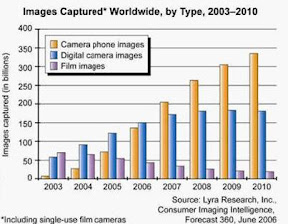
IMHO I think the group over at Future Imaging have pretty much nailed back in 2004 the unfolding macro/vision of what is really going on. The graph above is one of theirs and suggests two critical cross-overs.

The BIG DEAL first happened around mid-year 2003 when digital cameras on a units basis out sold film cameras - a non-Kodak moment as well! The other less well known event occurred when camera phones jumped over digital cameras but that went un-noticed as the images from the first camera phones really sucked - they still do in most cases. So what now? As we approach 2007, the Future Images group had the concept but missed the actual numbers by only 100 percent... Gosh it wasn't 350 million is was 800 camera phones!

The Lycra Research Group re-confirmed imagery industry disruption this past July when they published these next two graphs. They were a bit more forgiving in that their industry survey suggests that digital cameras only this past summer exceeded film cameras... (I guess that gave Kodak a bit more wiggle room?). But they too deliver the same message - camera phones simply will dominate.

http://www.lyra.com/lh3m.nsf/Home

Ok, now you are on to it. But the industry remains in turmoil. Back in 2004 I was able to watch Kodak joke and squirm with HP in that they too wished they could produce printer cartridges... a replacement for chemicals, films and special papers. So out came kiosks and "digital print centers" to get you and your memories on paper! NOT!!


So the last concept you need for this moment is to digest what the "image sharing" web sites are now doing to kiosks and print centers... Here is a rule of thumb to carry around.

According to Webshots (400 million images on their system - 17 million users - sharing around 85 percent of their images) out of 100,000 uploaded images under 1000 are printed. Active sharing rules...

Oh, and without "tagging" most shared images are useless?

That enough to get me in trouble so ...

Later,

MidNight Mapper