Showing posts with label digitial photo. Show all posts
Showing posts with label digitial photo. Show all posts
Monday, March 09, 2009


Friday, May 04, 2007
Dividing the Web Images Pie - Who has the largest slice?
Photo Web Sites Market Share
Apparently things are not really going well over at Flickr.
If Photobucket is around 2.5 billion images currently then the best guess of on-line imagery would suggest more than six billion images on-line - up from essentially zero eight years ago? Photobucket looks to be the dominate service by a factor of severn or eith over the next best Yahoo Photos. No wonder Microsoft is sniffing around buying Yahoo?
Monday, March 05, 2007
Senators Seek Better Defense Imagery
Senators Seek Better Imagery
Committee Wants More Photos, Video and Maps Available to Troops in Field
By Walter PincusWashington Post Staff Writer
Tuesday, June 6, 2006; Page A13
The Senate Select Committee on Intelligence wants to expand the mission of the nation's imagery intelligence agency so that it can provide U.S. forces on the ground with laptop computers that display still pictures and video of what may lie over the next hill.
"New products including full-motion video and ground-based photography should be included with available positional data [such as maps] in National Geospatial-Intelligence libraries for retrieval on Defense Department and intelligence community networks," the Senate panel said in its report on the fiscal 2007 intelligence authorization bill.
The Senate Select Committee on Intelligence wants to expand the mission of the nation's imagery intelligence agency so that it can provide U.S. forces on the ground with laptop computers that display still pictures and video of what may lie over the next hill.
"New products including full-motion video and ground-based photography should be included with available positional data [such as maps] in National Geospatial-Intelligence libraries for retrieval on Defense Department and intelligence community networks," the Senate panel said in its report on the fiscal 2007 intelligence authorization bill.
"The committee wants troops to be able to dial up what the route ahead will look like and where potential ambush points may be," said John Pike of GlobalSecurity.org, an expert in satellite- and ground-based intelligence. He said digital still photos taken by military attachés and Special Forces teams that have slipped in and out of potential target countries such as Iran and North Korea as well as video footage taken by unmanned aerial vehicles (UAVs) have been collected for years, but have not been integrated into the main data libraries maintained by the National Geospatial-Intelligence Agency (NGA).
"The NGA's current library of geospatial products reflects its heritage -- predominantly overhead imagery and mapping products," the committee wrote in its report. "While the NGA is beginning to incorporate more airborne and commercial imagery, its products are nearly devoid of FMV [full-motion video] and ground-based photography," it added.
The panel's solution is to give the director of national intelligence authority to direct the NGA to "analyze, disseminate and incorporate" into its national system "likenesses, videos, or presentations produced by ground-based platforms including handheld or clandestine photography taken by or on behalf of human intelligence collection organizations."
The new visual materials would be available along with traditional mapping data for retrieval by mission planners and troops in the field. "The route to and from a facility or photographs of what a facility would look like to a foot soldier -- rather than from an aircraft -- would be of immense value to our military personnel and intelligence officers," the report said.
Sensitive to the unique roles played by human collectors, including Special Forces teams and clandestine CIA operatives, the report made clear that the NGA's new mission would not give the agency authority to "manage or direct" the collection or set the technical requirements for "handheld or clandestine photography." The human collection agencies would also control the classification of their photography as well as how and to whom it is distributed.
Instead, the panel encouraged the NGA, whose database includes the exact location of where images are taken and the timing, to work with the other collection agencies so their data can easily be retrievable from the National Geospatial data libraries.
Pike said, however, that technical difficulties exist in finding ways to integrate the new collection into the NGA data libraries. "Lots of still-camera imagery does not have time and place stamped into it as do the satellites," he said. He also noted that full-motion videos, where a UAV can be traveling 100 mph, creates a problem in stamping locations so viewers know the start and finish of the target.
An NGA spokesman said the agency does not comment on pending legislation such as the Senate intelligence committee's version of the authorization bill. But the NGA has been making changes in its databases over the past few years. More commercial imagery has been purchased and some video from UAVs such at the Predator and Global Hawk have gone into the system.
Last December, Director of National Intelligence John D. Negroponte gave the NGA responsibility for overhead, non-imagery infrared and space-borne collectors of measurement and signature intelligence, which involves sensors that, among other things, gather signs of chemical, electronic, nuclear or other radiations emitters.
The NGA also has linked elements of its group with the National Security Agency, whose satellites and ground-based facilities collect electronic messages. Negroponte recently praised this step as "linking our nation's 'eyes and ears.' "
In a presentation last September, retired Lt. Gen. James R. Clapper Jr., the head of the NGA, described his view of "geointellingence" as seeking to answer such questions as "Where am I? Where are the friendlies? Where are the enemies? Where are the noncombatants? Where are the obstacles, natural and manmade, and how do I navigate among them? And what is the environment?"
Clapper, who became director of the NGA in 2001 when it was still the National Imagery and Mapping Agency, plans to retire this month.
Monday, January 22, 2007
One Billion Cameras -
What Happens When A Billion People Worldwide Become Equipped With The Tools Of Visual Communication?
In the past four years the number of cameras in people’s hands worldwide has increased by 600%. It will double again over the next five years. Total number of cameras of all kinds sold in 2000: 85 Million units. Projected 2008 sales: One Billion units. Pervasive, web-connected imaging and the explosion of user-generated visual content are transforming how we communicate with each other in our personal, work, and community lives.
What happens when a billion users of many cultures, and scores of engineers and entrepreneurs, focus on new ways to enrich customers’ lives through imaging? What happens when R&D is fueled by an order-of-magnitude increase in economic reward? And what happens to the industry’s business models and value formulas?
FutureImage - 6Sight
Monday, December 11, 2006

Saturday, December 09, 2006
Camera Phone Domination and Photo-tagging
I have hunted around the blogo-sphere and have not really found anyone pealing back the onion on the macro trends of digital imagery. So here goes... sweeping commentary and a few links that may confirm the issues.
The single most important idea you need to agree to: once camera phones gets more than 2-3 mega pixels resolution they (will) take over the role of digital cameras for most applications and users. BUT, the argument goes camera phones still are in need of better a lens. Well that too is coming in the next year likely.
Interesting almost factoid - for a huge portion of the world, the first camera they ever will own will be integrated into their mobile phone.
Why is this important? Well for those just now getting involved with the industry of digital cameras and its total disruption of film and chemical photography, the camera phone is truly the disruptive technology that is killing analog cameras... other than disposables, and is poised to do the same to most forms of digital cameras as well. Hence the better lensed SLR designs that are going to be gift choices this season?
The big picture?

http://www.mobileimagingreport.com/Mobile_Imaging.htm
IMHO I think the group over at Future Imaging have pretty much nailed back in 2004 the unfolding macro/vision of what is really going on. The graph above is one of theirs and suggests two critical cross-overs.
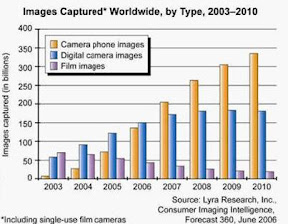
The BIG DEAL first happened around mid-year 2003 when digital cameras on a units basis out sold film cameras - a non-Kodak moment as well! The other less well known event occurred when camera phones jumped over digital cameras but that went un-noticed as the images from the first camera phones really sucked - they still do in most cases. So what now? As we approach 2007, the Future Images group had the concept but missed the actual numbers by only 100 percent... Gosh it wasn't 350 million is was 800 camera phones!
The Lycra Research Group re-confirmed imagery industry disruption this past July when they published these next two graphs. They were a bit more forgiving in that their industry survey suggests that digital cameras only this past summer exceeded film cameras... (I guess that gave Kodak a bit more wiggle room?). But they too deliver the same message - camera phones simply will dominate.

http://www.lyra.com/lh3m.nsf/Home
Ok, now you are on to it. But the industry remains in turmoil. Back in 2004 I was able to watch Kodak joke and squirm with HP in that they too wished they could produce printer cartridges... a replacement for chemicals, films and special papers. So out came kiosks and "digital print centers" to get you and your memories on paper! NOT!!
So the last concept you need for this moment is to digest what the "image sharing" web sites are now doing to kiosks and print centers... Here is a rule of thumb to carry around.
According to Webshots (400 million images on their system - 17 million users - sharing around 85 percent of their images) out of 100,000 uploaded images under 1000 are printed. Active sharing rules...
Oh, and without "tagging" most shared images are useless?
That enough to get me in trouble so ...
Later,
MidNight Mapper
Subscribe to:
Posts (Atom)



 Posts
Posts

